






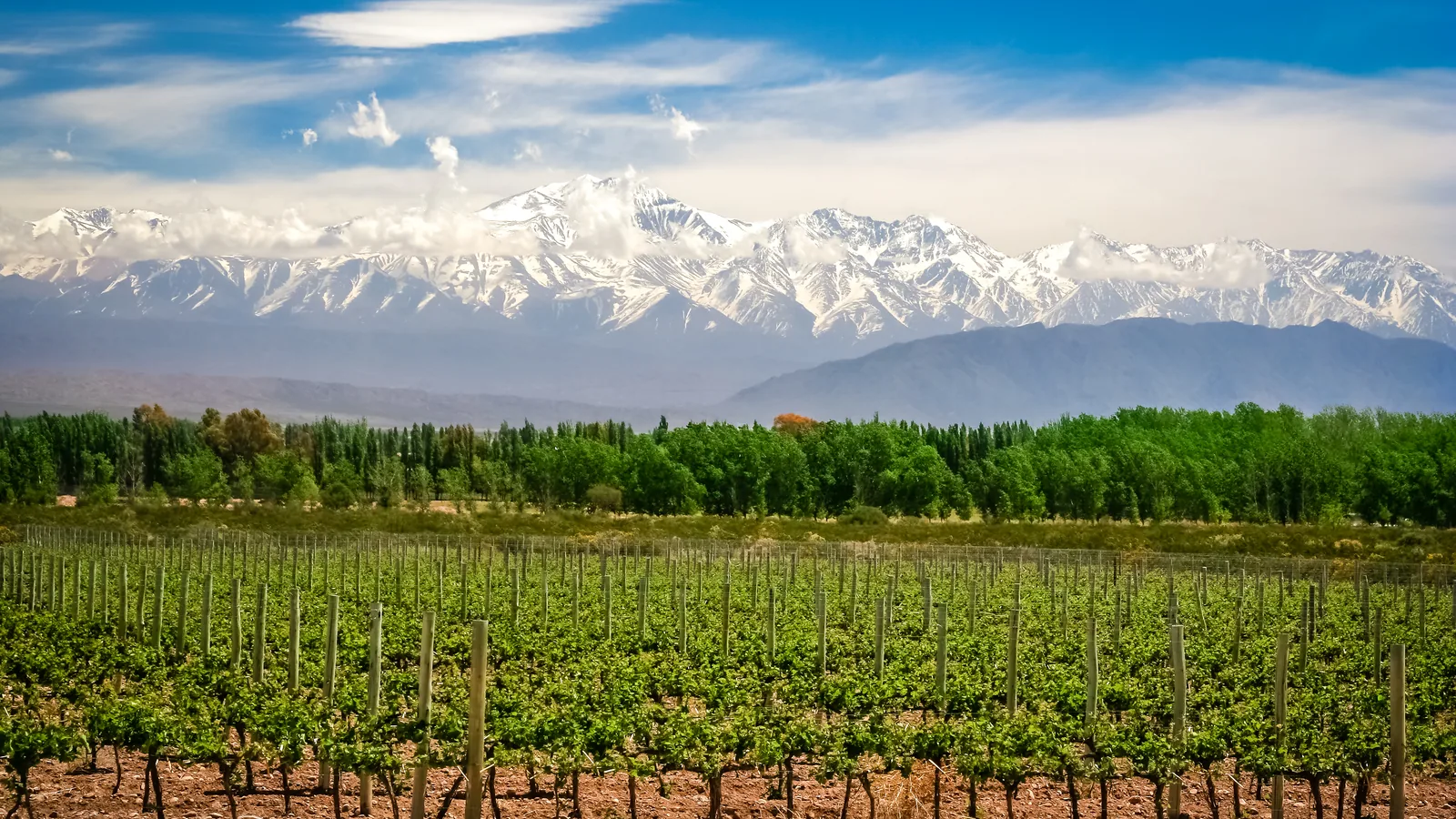
Argentine Malbec is grown higher than most of the world's wine grapes, in a dry corner of the country tucked against the Andes. That altitude, and the desert climate around it, explain much of how Mendoza Malbec differs from the grape's original home in southwest France. Here is the geography, the history and the calendar behind the bottle.
A French grape that found a second home
Wines of Argentina, the country's wine export and promotion body, traces Malbec to southwest France, where it is known as Côt. It credits Michel A. Pouget, a French agronomist hired by the Argentine government to run the Agricultural Quinta of Mendoza, with bringing the grape to Argentina in 1853. The group also notes that Argentina was one of the few wine regions that stayed free of phylloxera, the vine pest that took hold in France in 1863.
Today Mendoza is the center of it all. In data from the National Viticulture Institute (INV, Argentina's wine regulator) published by Wines of Argentina, Mendoza holds about 149,000 hectares of wine grapes, roughly 75 percent of the national total, and Malbec covers about 38,600 hectares there, more than a quarter of the province's vineyards. Of all the Malbec in Argentina, about 85 percent grows in Mendoza.
Altitude and a desert climate
Mendoza's vineyards run from about 430 to 2,000 meters above sea level, or about 1,411 to 6,562 feet, according to Wines of Argentina. Average rainfall is about 220 millimeters a year, compared with figures the same source gives of 599 for Napa and 851 for Bordeaux. Vineyards depend on irrigation, and the group credits the Andes with shaping the climate that makes grape growing possible there.
Wines of Argentina divides the province into five sub-regions, with these vineyard altitude ranges:
- Uco Valley: about 860 to 1,610 meters (2,800 to 5,282 feet)
- Primera Zona (Luján de Cuyo and Maipú, just south of Mendoza city): about 615 to 1,300 meters
- North Mendoza: about 575 to 710 meters
- East Mendoza: about 500 to 690 meters
- South Mendoza (San Rafael and General Alvear): about 430 to 885 meters
The Uco Valley up close
The Uco Valley is the high end of that range, and a name worth looking for on a label. It is a geographical indication (GI, Argentina's legally defined place-of-origin name) made up of three departments: Tupungato, Tunuyán and San Carlos. Wines of Argentina reports about 28,900 hectares of vineyards in the valley, about 15,700 of them Malbec. That is about 41 percent of Mendoza's Malbec and about 34 percent of all Argentina's.
Much of the planting is recent. In Tunuyán, the group says new high-altitude land at the foot of the Andes was developed from 1995 onward, with all new areas planted above 1,000 meters, and that by around 2010 it had become clear these vineyards produced a distinct style. That push to understand the land led to smaller GIs inside the valley, including Los Chacayes, Vista Flores and San Pablo in Tunuyán, and Paraje Altamira in San Carlos. Los Chacayes, for example, sits between 1,000 and 1,500 meters with about 280 millimeters of annual rain.
Why it differs from Cahors
Malbec's French homeland is Cahors, along the Lot River. The Cahors wine council says the appellation was created in 1971, is reserved for red wine, and requires at least 70 percent Malbec, with Merlot and Tannat as the permitted secondary grapes. About 3,323 hectares were planted there in 2020, a fraction of Mendoza's Malbec alone.
Wines of Argentina describes the French tradition of Côt as tannic and firm. It describes Malbec from the Cuyo region, which includes Mendoza, as ruby red with plum, fig and quince aromas and alcohol levels that give a soft, smooth feel, and it describes Argentine Malbec more broadly as deep violet in color with sweet, soft tannins. In practical terms: expect a Cahors to lean firmer and more structured, and remember it can include up to 30 percent Merlot or Tannat; expect a Mendoza Malbec to lean riper and softer.
A Southern Hemisphere calendar
Argentina's seasons run opposite to North America's, so the harvest comes in the first months of the calendar year. The INV published its 2026 pre-harvest estimates on February 2 for San Juan and February 9 for Mendoza, and released its final count on May 19, 2026: 18,391,299 quintals of grapes nationwide, 8 percent less than in 2025, with 13,147,187 quintals from Mendoza. That timing means an Argentine Malbec labeled 2026 was picked and counted by the middle of the year, while vineyards north of the equator were still waiting for their 2026 grapes to ripen.
Your next step
On the next Malbec you buy, look past the word Mendoza for a smaller place name: Uco Valley, Tupungato, Tunuyán, Los Chacayes, Paraje Altamira, or Luján de Cuyo in the Primera Zona. Comparing an Uco Valley bottle with one from a lower sub-region is the simplest way to see what altitude changes.
Loading comments…