



Most red Bordeaux is a blend, and the label rarely names the grapes. What it does name is a place, and in Bordeaux the place tells you a great deal about what is in the bottle. The shorthand is Left Bank and Right Bank, the two sides of the water that splits the region. Learn what each side grows and which lines on the label are regulated, and a Bordeaux shelf gets much easier to shop.
Two banks, two lead grapes
The Bordeaux Wine Council (the CIVB, the region's interprofessional body) gives the makeup of red Bordeaux as about 66 percent Merlot, 22 percent Cabernet Sauvignon and 9 percent Cabernet Franc, with smaller amounts of other permitted grapes. How those grapes are spread across the map is what separates the banks.
The Left Bank is the Médoc peninsula, between the Atlantic and the Gironde estuary, plus the Graves area to the south. The CIVB calls the Médoc a stronghold of Cabernet and notes that only red wine is made there. Cabernet Sauvignon is most at home on the warm, gravelly soils of the Médoc and Graves. It ripens late, usually 7 to 12 days after Merlot, and the CIVB describes its wines as structured, with firm tannins (the drying, grippy compounds from grape skins and seeds), black fruit such as cassis, and the ability to age.
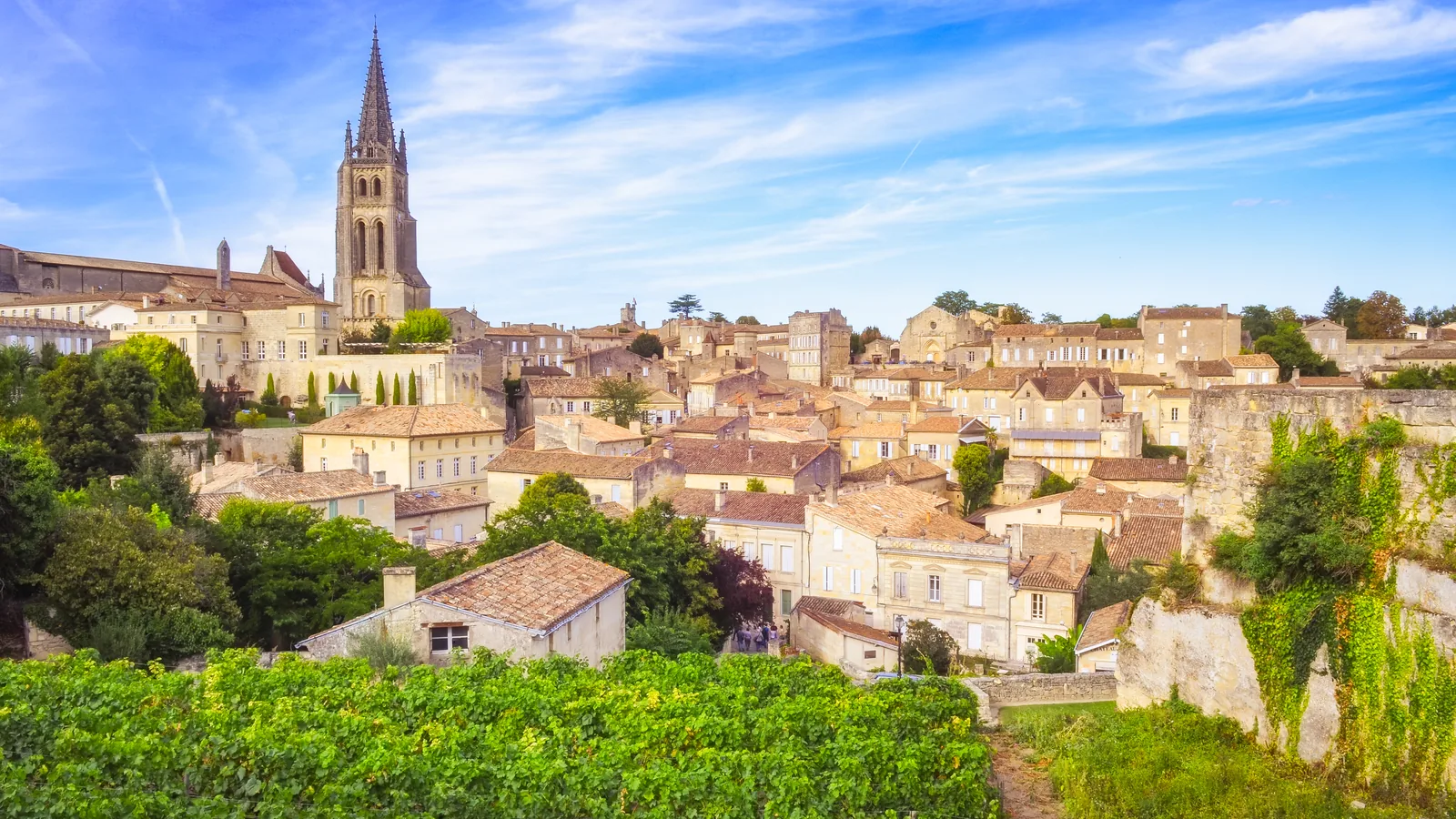
The Right Bank centers on Saint-Émilion, Pomerol and Fronsac, above the Dordogne River. Here the vineyards sit on a mix of limestone plateaus and clay, and Merlot is the main grape, with the Cabernets adding structure. Merlot ripens early, and the CIVB describes it as supple and rounded, with cherry and plum fruit.
The CIVB itself calls the Left Bank Cabernet, Right Bank Merlot split a simplification. Both banks blend, and Cabernet Sauvignon is also grown, to a lesser extent, in Saint-Émilion, Pomerol and Fronsac. Treat the bank as a strong hint about the dominant grape, not a guarantee.
The appellations you will see
An appellation is a legally defined place of origin with its own production rules. France's national origin agency, INAO, explains that producers write the rulebook (the cahier des charges) for each appellation and that independent bodies approved by INAO check compliance. In the European Union this status is called a Protected Designation of Origin, and French wines may keep using the older term Appellation d'Origine Contrôlée (AOC).
On the Left Bank, the CIVB lists eight Médoc appellations: Médoc, Haut-Médoc, Listrac-Médoc, Moulis, Margaux, Pauillac, Saint-Julien and Saint-Estèphe. On the Right Bank it lists Saint-Émilion and its satellites (Lussac, Montagne, Puisseguin and Saint-Georges Saint-Émilion), Pomerol, Lalande de Pomerol, Fronsac, Canon Fronsac, and Castillon and Francs Côtes de Bordeaux. Covering the whole region are the broad Bordeaux and Bordeaux Supérieur appellations.
How to read the label
The château. In Bordeaux, a château is the estate that grows and makes the wine. Its name is usually the biggest word on the front label, and it is a brand, not a place of origin.
The appellation. This is the regulated line, and the CIVB notes it is a mandatory mention. Look for the appellation name set between the words Appellation and Contrôlée, for example Appellation Pauillac Contrôlée. A Pauillac or Margaux points you to the Left Bank; a Pomerol or Saint-Émilion to the Right.
The classification, if any. Some labels add a rank. The 1855 Classification, drawn up by Bordeaux's wine brokers for that year's Paris Universal Exhibition, ranks 60 red wine estates in the Médoc plus Château Haut-Brion in Graves in five tiers, from Premier to Cinquième Cru, along with 27 sweet white estates in Sauternes and Barsac. A label line such as Grand Cru Classé en 1855 refers to it. Other systems include the Graves classification, the Crus Bourgeois du Médoc and the Saint-Émilion classification, which the CIVB says is revised every decade.
Grand Vin. These words often appear near the château name. Grand Vin is not an appellation and is not one of the classifications the CIVB lists, so the regulated information is still in those two lines. It makes most sense read against how estates organize their range: the CIVB explains that many leading châteaux make a first wine, often from their oldest vines and built to age, and second or third wines from younger vines on the same land, blended to be fruit-forward and approachable at a lower price.
Your next step
At the shop, find two bottles at a similar price, one from a Left Bank appellation such as Haut-Médoc and one from a Right Bank appellation such as a Saint-Émilion satellite. Read each label from the appellation line up, then taste them side by side to see the Cabernet and Merlot difference for yourself.
Sources
- Bordeaux Wine Council (CIVB): The art of the blend
- Bordeaux Wine Council (CIVB): Cabernet Sauvignon
- Bordeaux Wine Council (CIVB): Merlot
- Bordeaux Wine Council (CIVB): The Médoc appellations
- Bordeaux Wine Council (CIVB): Saint-Émilion, Pomerol and Fronsac
- Bordeaux Wine Council (CIVB): Bordeaux designations
- Bordeaux Wine Council (CIVB): Bordeaux appellations explained (in French)
- Bordeaux Wine Council (CIVB): Bordeaux wine classifications
- Bordeaux Wine Council (CIVB): The 1855 classification
- Bordeaux Wine Council (CIVB): The art of blending, first and second wines
- INAO: Protected Designation of Origin (AOC/AOP)
Loading comments…