


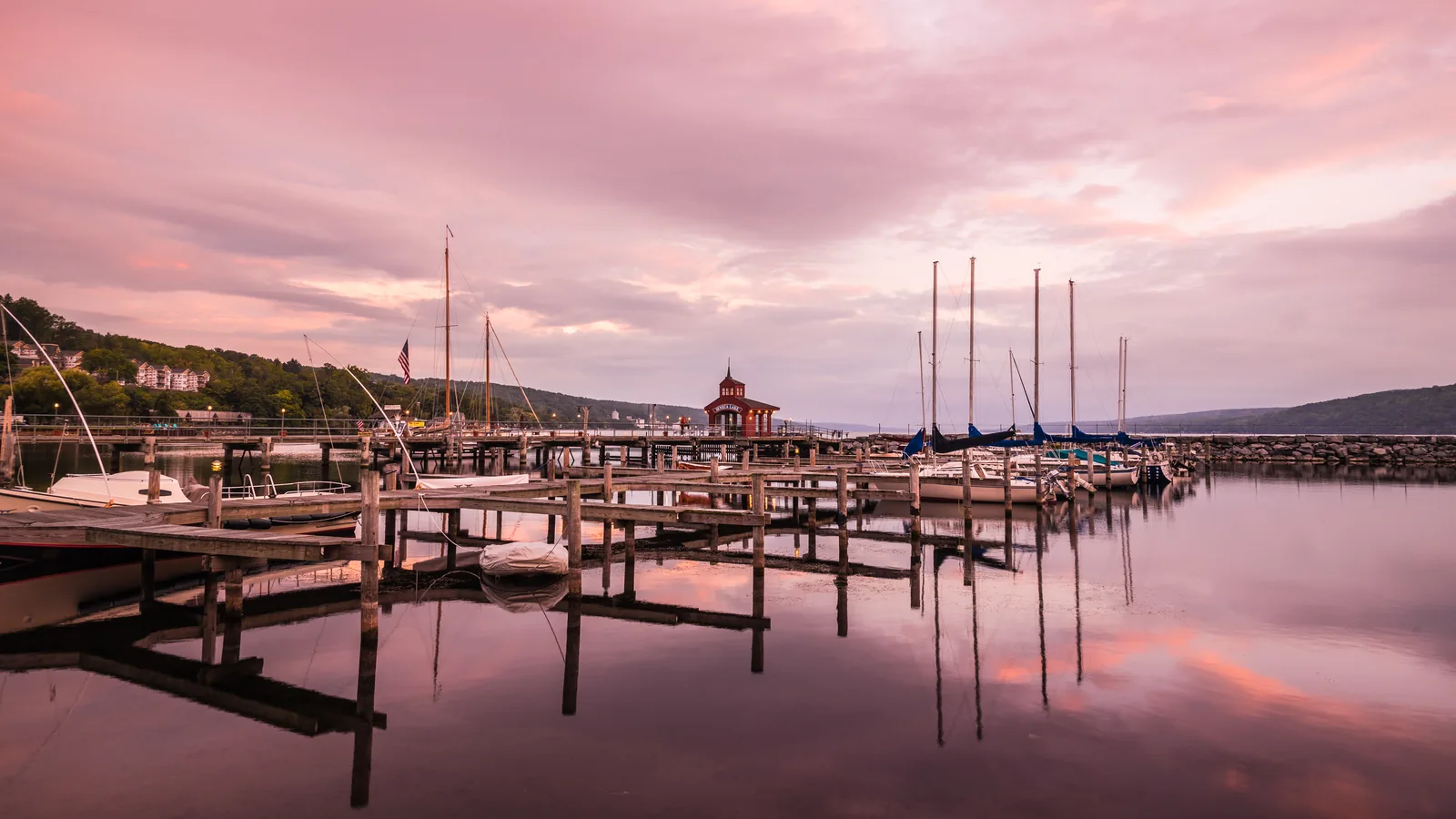
Riesling is the grape most people associate with the Finger Lakes, and the reason sits at the bottom of the region's lakes. Glaciers carved a set of long, narrow, very deep valleys in upstate New York, and the water that filled them acts like a heat battery for the vineyards on their slopes. Once you understand that, and the small sweetness scale printed on many back labels, buying Finger Lakes Riesling gets a lot easier.
Deep water, steady temperatures
The Finger Lakes Wine Alliance, the region's winery group, says successive glaciers carved the valleys thousands of years ago, with cuts as deep as 618 feet below sea level. Cornell AgriTech, Cornell University's agricultural research campus in Geneva, New York, gives the depths of the main wine lakes: Seneca at 632 feet and Cayuga at 435 feet, compared with Keuka at 187 feet and Canandaigua at 262 feet.
Depth matters because a large body of deep water changes temperature slowly. The New York Wine & Grape Foundation, the state's industry body, explains the cycle: the lakes absorb heat from spring through summer and give it back in the fall. In spring, cooler air near the water delays bud break (the point when the vine's buds open), which helps protect young shoots from spring frost. In autumn, the stored warmth extends the season. Cornell adds that Lake Ontario moderates temperatures across the whole region and the Finger Lakes add a local effect on top of it. Seneca and Cayuga, the deepest and lowest of the group, rarely freeze, give the most moderation and have the longest growing season. The higher, shallower Keuka and Canandaigua still moderate winter cold but are more prone to early fall frost. The Foundation also notes that climate change may make this lake effect less predictable.
For Riesling, a cool-climate grape known for high acidity, that steady, extended season is the point. The Wine Alliance describes Finger Lakes Riesling as defined by high acidity, citrus and orchard fruit, subtle floral notes and a mineral quality, with the long ripening period contributing to fruit purity and concentration.
The AVAs on the label
An American Viticultural Area (AVA) is a federally defined grape-growing region with distinct geographic or climatic features. There are three in the Finger Lakes:
- Finger Lakes AVA, established in 1982, the umbrella appellation. The New York Wine & Grape Foundation counts 144 wineries and about 10,700 acres of vineyard across 423 farms.
- Cayuga Lake AVA, established in 1988 as the first single lake to gain AVA status. The lake is about 40 miles long, the longest of the eleven Finger Lakes, and the Wine Alliance lists 460 planted acres, led by Riesling.
- Seneca Lake AVA, established in 2003, with about 3,700 acres under vine. Riesling leads here too, followed by Cabernet Franc, Chardonnay, Pinot Noir and Gewürztraminer.
Citing the Foundation's 2024 vineyard report, the Wine Alliance puts Finger Lakes Riesling at 832 acres. Many producers make several Rieslings, ranging from bone dry to sweet, including late-harvest wines and ice wines.
Dry, semi-dry, sweet: reading the scale
That range is exactly why the word Riesling alone does not tell you how sweet a bottle will taste. The International Riesling Foundation created a taste profile scale to solve this, and the New York Wine & Grape Foundation notes that New York wineries use it to show sweetness. The scale has four categories: Dry, Medium Dry, Medium Sweet and Sweet. The Foundation's own label guide uses the words dry, semi-dry, semi-sweet and sweet for the same four steps.
The winemaker places an arrow along the scale. Under the International Riesling Foundation's guidelines, that placement comes from how the wine's residual sugar (the grape sugar left unfermented), its acidity and its pH interact, not from sugar alone. Acidity makes a wine taste less sweet, which is why the scale weighs the balance rather than a single sugar number. The same four categories are used to sort Rieslings for judging at the New York Wine Classic, the state's annual competition run by the Foundation.
Use of the scale is voluntary, so not every bottle carries it. When it is missing, look for the words dry or semi-dry on the front label, or check the producer's technical sheet, which often lists residual sugar.
Two more label clues
The Foundation's label guide points to two other federal rules worth knowing. A wine named for a single grape, such as Riesling, must contain at least 75 percent of that grape. And estate grown means all the grapes came from land the winery owns or controls within a viticultural area.
Your next step
Next time you shop, pick up two Finger Lakes Rieslings with arrows at different points on the scale, one Dry and one Medium Sweet, and taste them side by side. It is the quickest way to learn where your own preference sits on that bar.
Sources
- Finger Lakes Wine Alliance: Quick facts
- Finger Lakes Wine Alliance: Seneca Lake AVA
- Finger Lakes Wine Alliance: Cayuga Lake AVA
- Finger Lakes Wine Alliance: Riesling
- New York Wine & Grape Foundation: Finger Lakes AVA
- New York Wine & Grape Foundation: How to read a wine label
- New York Wine & Grape Foundation: New York Wine Classic and the Riesling Taste Profile
- Cornell CALS Viticulture and Enology: New York grape growing regions
Loading comments…