






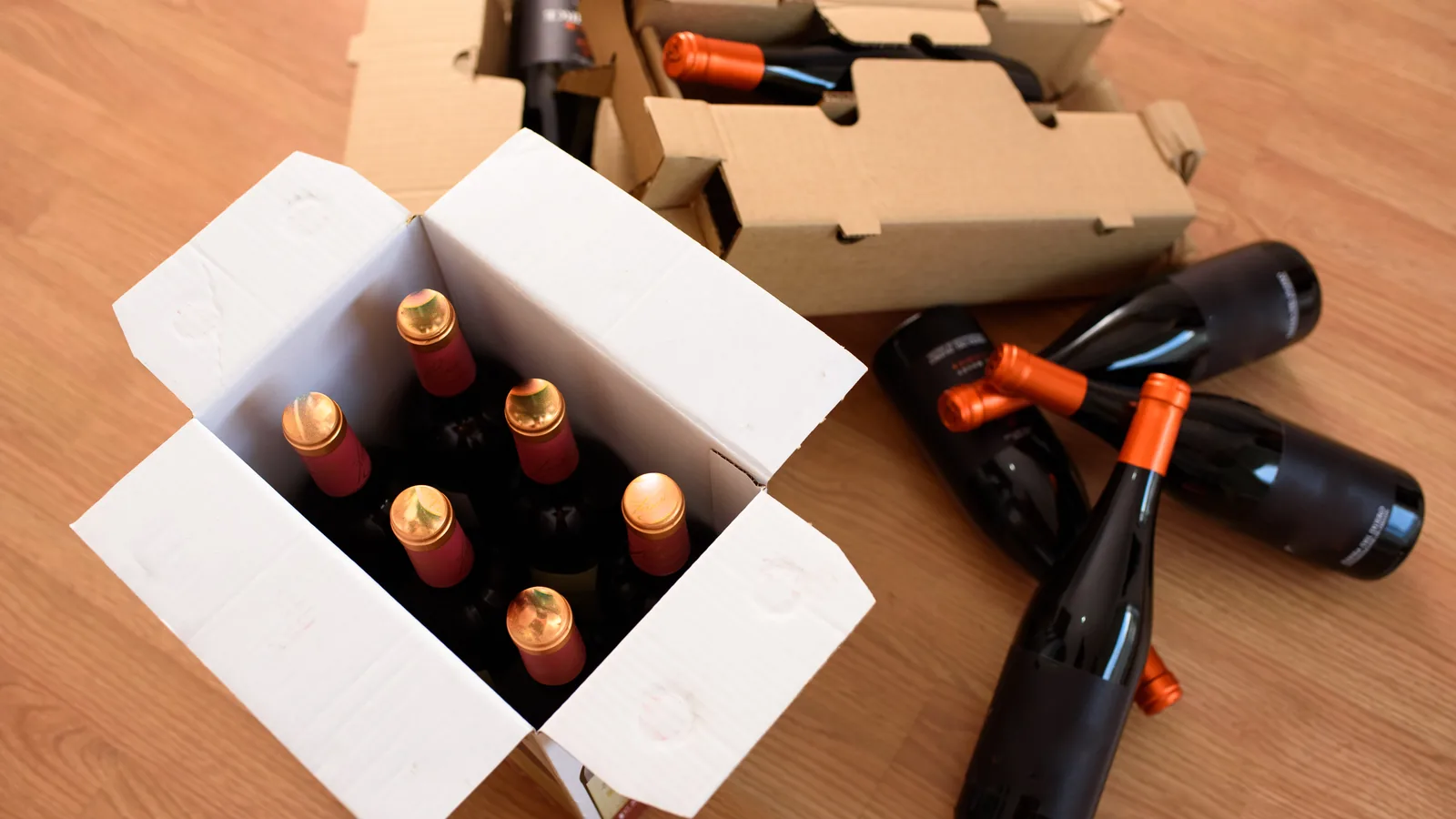
Order a case from a winery in California and it may arrive at your door in two days, while a friend two states over is told the same winery cannot ship to them at all. The difference is not the winery's choice. It comes from how alcohol has been regulated in the United States since the end of Prohibition, and from a 2005 Supreme Court case that reshaped direct shipping.
The three-tier system
Most alcohol in the United States moves through what is called the three-tier system: producers sell to licensed wholesalers (also called distributors), wholesalers sell to licensed retailers and restaurants, and retailers sell to you. Each tier needs its own license. The Supreme Court described this structure in Granholm v. Heald and confirmed that states may require it. The Twenty-first Amendment, which ended Prohibition, gives each state wide power over how alcohol is sold within its borders, which is why the rules differ so much from one state line to the next.
Direct-to-consumer shipping, often shortened to DTC, skips the middle tiers: a winery or retailer ships a bottle straight to a buyer's home. The Wine Institute, the trade group for California wineries, defines it as a sale shipped by a common carrier from a winery directly to an adult consumer's home or office for personal use.
What Granholm v. Heald decided
Before 2005, Michigan and New York let wineries inside their own borders ship directly to consumers while effectively blocking out-of-state wineries from doing the same. In its decision of May 16, 2005, written by Justice Anthony Kennedy, the Court held that both states' laws discriminated against interstate commerce and violated the Commerce Clause of the Constitution. The Court also held that the Twenty-first Amendment does not protect a state law that favors its own producers over out-of-state ones.
The ruling did not require any state to allow direct shipping. It required fairness: if a state lets its own wineries ship to residents, it has to give out-of-state wineries the same opportunity on equal terms. That is why states responded in different ways. Most opened direct shipping to wineries everywhere under a permit; a few kept tight limits or none at all.
Where things stand by state
The National Conference of State Legislatures, which tracks state law, reports that most states now have laws allowing out-of-state producers to ship directly to consumers, and that most of those laws cover wine only. The details vary, but the same requirements show up again and again:
- A state direct shipper permit or license, often tied to the winery's federal permit.
- Volume caps per household, set by the year, the month or the shipment.
- Age verification at the time of sale, confirming the buyer is at least 21.
- Collection of the state's sales and excise taxes as if the sale happened in the buyer's state.
- Regular reports and records the state can audit.
Two examples show the range. The Wine Institute lists Utah as a state where shipping wine to consumers by common carrier is prohibited and treated as a felony. Mississippi, by contrast, opened winery shipping on July 1, 2025, with a $100 annual permit, a limit of 12 cases per address per year and a 15.5% direct wine excise tax on top of its 7% use tax.
Wineries versus retailers
Granholm was about wineries, and many state laws treat wineries and retailers differently. A state that welcomes shipments from an out-of-state winery may still bar shipments from an out-of-state wine shop. The NCSL summary notes examples on both sides: Idaho lets its licensed retailers ship a limited amount to residents of other states that offer the same in return, and Connecticut issues a separate permit for out-of-state retailers. When a retailer's checkout page says it cannot ship to your state, this is usually why.
Signing for the box
Expect to be home, or to pick it up. The Wine Institute's shipping FAQ states that wine deliveries require the signature of an adult 21 or older, that there is no signature waiver, and that the carrier must hand the package to a person who can show ID rather than leave it at the door. FedEx requires an adult signature on every US alcohol shipment and checks that the recipient is 21 or older with valid ID; if no one is available, the package can be rerouted to another address in the same state for a fee. Carriers accept alcohol only from licensed businesses that have signed an alcohol shipping agreement, which is also why individuals cannot ship wine to friends: the Wine Institute notes that the US Postal Service will not carry alcohol and that FedEx and UPS do not accept it from individuals.
Before you order
Check the winery or retailer's shipping page for your state before you fill a cart, have the box sent to an address where an adult 21 or older will be there to sign during the day, and keep your ID handy at delivery. For anything unclear, your state's alcohol beverage control agency publishes its own rules.
Wine shipping rules vary by state, and some states limit or bar shipping wine directly to consumers. Check what your state allows before you order.
Sources
- Supreme Court of the United States (via Cornell Legal Information Institute): Granholm v. Heald, 544 U.S. 460 (2005), opinion of the Court
- National Conference of State Legislatures: Direct shipment of alcohol state statutes
- Wine Institute: Direct-to-consumer shipping laws for wineries
- Wine Institute: State shipping laws FAQs
- Wine Institute: Utah direct shipping summary
- Wine Institute: Mississippi direct shipping summary
- FedEx: Shipping alcohol
Loading comments…