






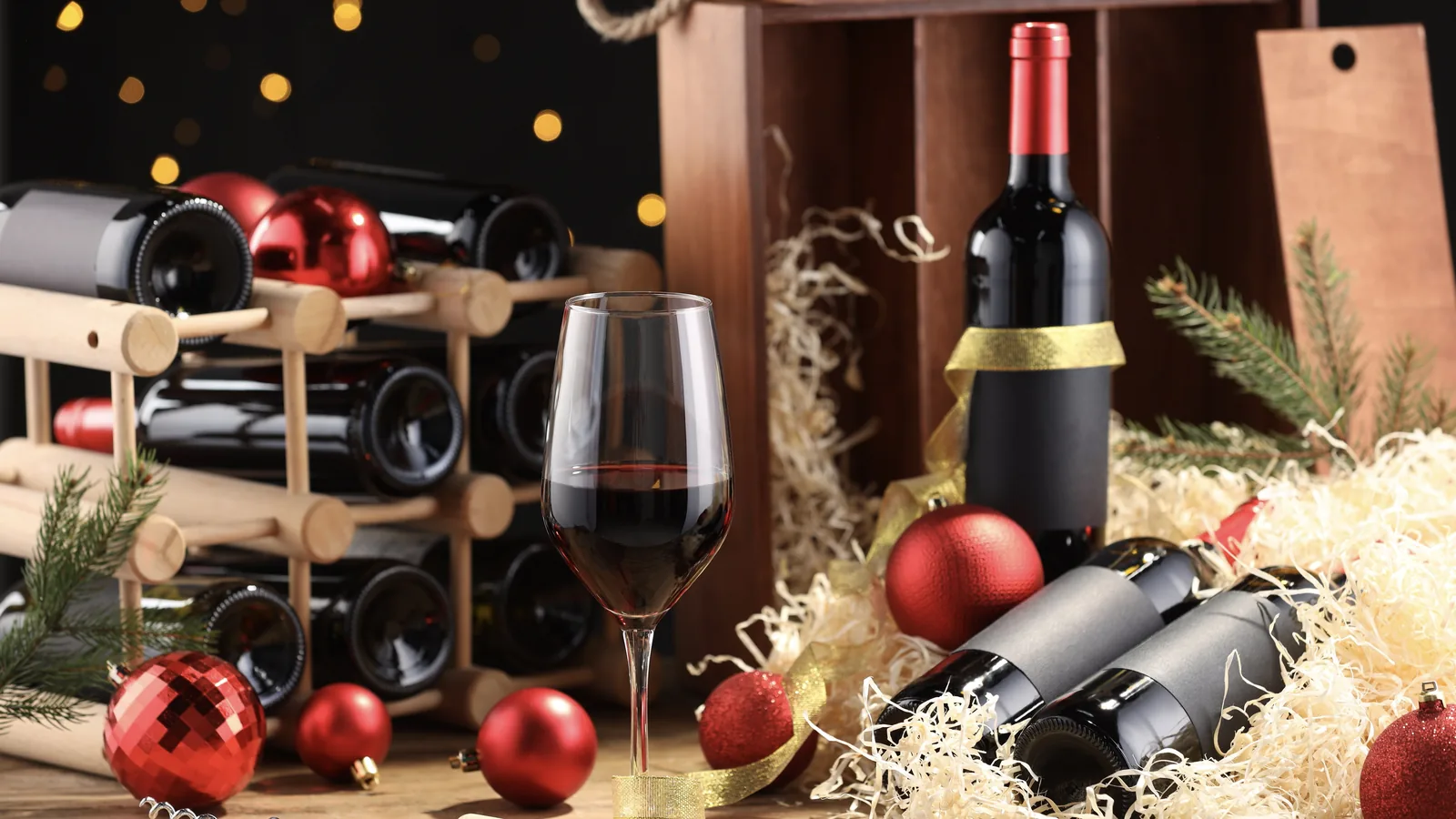
Buying wine for a holiday party comes down to a little arithmetic and a few decisions you make before you get to the store: how many people, how long the party runs, what you are serving and how everyone is getting home. Here is how to work it out so you neither run dry by nine o'clock nor end up with three cases in the garage.
Start with the bottle
A standard wine bottle holds 750 milliliters, which is about 25 fluid ounces. The National Institute on Alcohol Abuse and Alcoholism, a federal research agency, uses 5 fluid ounces of table wine at about 12% alcohol as its measure of one standard drink. Divide 25 by 5 and a bottle pours about five 5-ounce glasses. That five-glass figure is the number every calculation below uses. If your glasses are large or your pours run generous, you will get fewer; a stemless tumbler filled halfway can hold far more than 5 ounces.
A planning table by party length
A simple planning assumption is one glass per guest for each hour of the party. That figure is meant as a ceiling for buying, not a target for anyone's glass: some guests will have one glass all evening, some will have none, and a ceiling means you will not run out. Start with the number of guests who drink wine, not the full guest list, then use the table.
| Wine-drinking guests | 2-hour party | 3-hour party | 4-hour party |
|---|---|---|---|
| 10 | 4 bottles | 6 bottles | 8 bottles |
| 20 | 8 bottles | 12 bottles | 16 bottles |
| 30 | 12 bottles | 18 bottles | 24 bottles |
The math behind each cell: guests times hours equals glasses, and glasses divided by five equals bottles. For a guest count that is not on the table, run the same two steps and round up to the next whole bottle. If beer, cocktails or a punch are also on offer, scale the wine down to match.
Splitting red, white and sparkling
There is no fixed formula, so let the menu and the room decide. A few working rules:
- Sparkling goes fastest at the start and at any toast. If there is a toast, count one small pour for every guest who will raise a glass; a bottle gives six to eight short toasting pours.
- White and rosé suit appetizers, seafood and a warm, crowded room.
- Red carries a sit-down dinner with roasts, braises or a cheese board, and winter parties tend to lean red.
For a mixed cocktail party with no dinner, a starting point of roughly a third each of red, white and sparkling is easy to adjust. If you are unsure, buy a few extra bottles of whichever style your crowd usually reaches for; a sealed bottle keeps until the next occasion.
Set up before the doorbell
- Chill whites, rosé and sparkling in the refrigerator the day before, then move them to an ice bucket with ice and water when guests arrive. Water around the ice chills bottles faster than ice alone.
- Open a couple of bottles of each style at the start and keep the rest sealed, so leftovers stay unopened.
- Put out water and at least one appealing drink without alcohol, such as sparkling cider, a nonalcoholic wine or a seasonal spritz, where guests can find it without asking.
- Serve food throughout the party, not just at the start.
Keeping open bottles
When the party winds down, push the cork back in or use a wine stopper, and put open bottles in the refrigerator, reds included. Cold slows the changes that oxygen causes once a bottle is open. Sparkling wine keeps best with a clamp-style stopper made for it. Open bottles are best finished within a few days, so plan a leftovers dinner around them.
Everyone gets home safely
The last part of hosting is the ride home. Ask guests to plan their trip before they arrive, the same way you plan the wine. Practical ways to do it:
- Put local taxi and rideshare information by the door, or offer to call a car.
- Ask whether any guest is driving and make sure they have good drinks without alcohol all night.
- Stop opening new bottles an hour or so before the party ends and bring out coffee and dessert.
- If you have room, offer a couch or guest room to anyone who would rather stay.
Your shopping list
Count your wine-drinking guests, pick the party length, find your number in the table and round up a bottle or two. Then ask your wine shop whether it offers a case discount and whether it will take back unopened bottles, since policies differ from shop to shop and state to state.
Loading comments…