






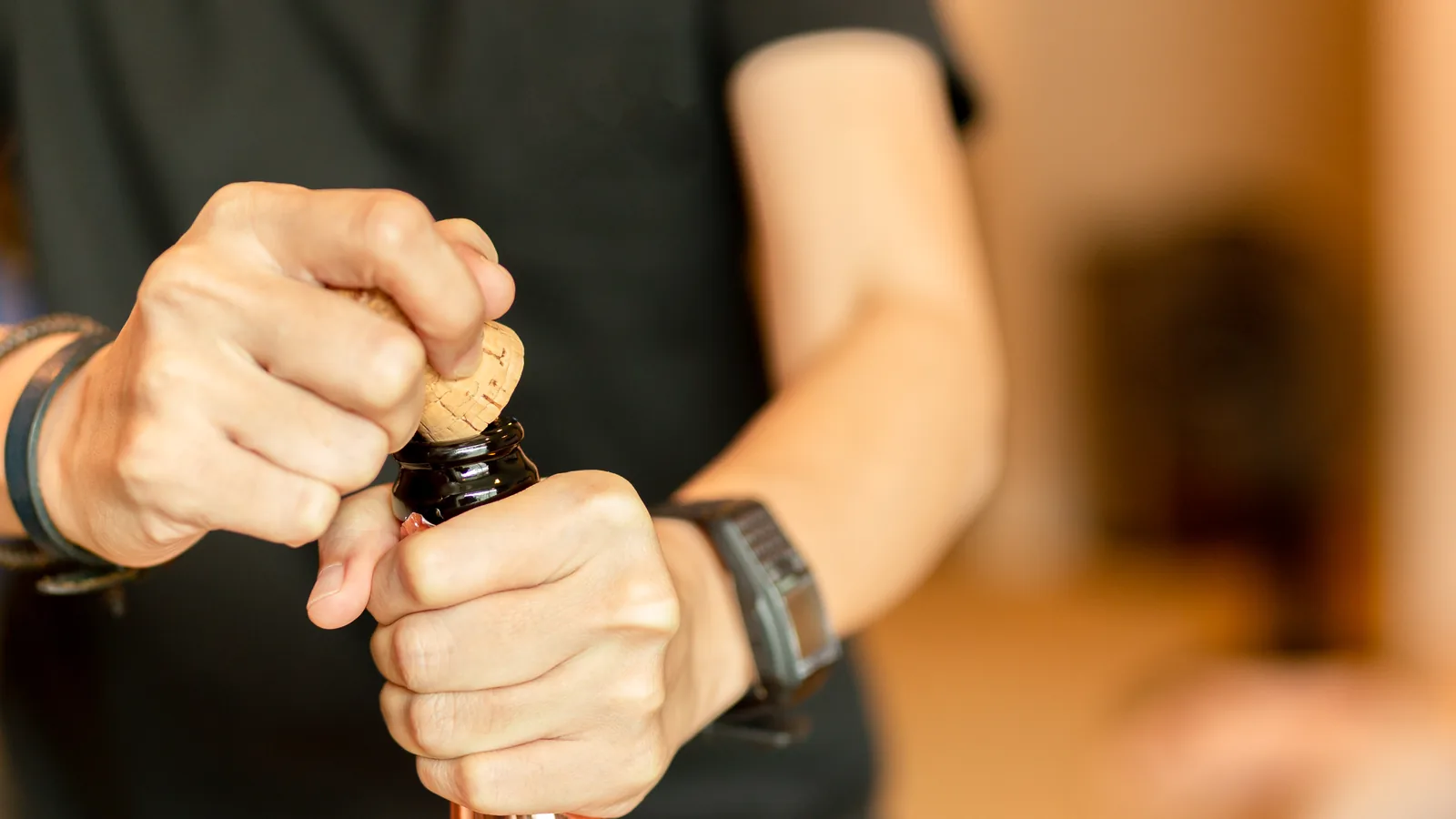
The loud pop and the flying cork look festive in movies. At home, they are the part of opening sparkling wine most likely to go wrong. A cork leaves a bottle under real pressure, and the safest way to open one is also the quietest: a soft hiss, with the cork held in your hand the whole time.
Why the cork is the hazard
Sparkling wine, whether Champagne, Prosecco, Cava or an American sparkling wine, holds dissolved carbon dioxide under pressure, which is what makes the bubbles. The American Academy of Ophthalmology, the professional society for eye physicians, warns that a cork can leave the bottle at up to 34 miles per hour, fast enough to break glass. If it strikes an eye, the academy lists bleeding, scratches to the eye's surface and glaucoma among the injuries it can cause, and it notes that some problems appear only years later, which is why follow-up care matters. Shaking the bottle raises the pressure further.
Step 1: Chill it well
The academy's first step is to chill the bottle, because gas expands as it warms. A cold bottle opens more gently and foams less. Give it several hours in the refrigerator, or about 20 to 30 minutes in an ice bucket filled with ice and water. Do not move it straight from a warm car or a sunny counter to the table and open it.
Step 2: Do not shake it, and aim it away from people
Carry the bottle gently. Hold it at about a 45-degree angle, base lower than the neck, and point it away from yourself, your guests, light fixtures and anything breakable. The academy recommends exactly this angle and direction.
Step 3: Remove the foil and loosen the wire cage
Peel off the foil. Under it, a twisted wire cage, sometimes called a muselet, holds the cork in place. From the moment you start untwisting the cage, keep your thumb pressed on top of the cork. Some corks start to move as soon as the wire loosens.
Step 4: Cover with a towel and twist the bottle, not the cork
Drape a folded kitchen towel or cloth napkin over the cork and grip the cork firmly through it. Then, as the academy describes, slowly and firmly turn the base of the bottle while you hold the cork still, keeping downward pressure on the cork so it does not shoot out. Twisting the bottle gives you more control than twisting the cork. As the cork eases free, let the gas escape slowly. You should hear a sigh, not a bang, and the cork stays in your hand inside the towel.
Step 5: Pour slowly
Pour a small amount into each glass first, let the foam settle, then top it up. Tilting the glass slightly as you pour helps keep the foam down. When you toast, the academy suggests clinking gently so glasses do not break.
If a cork hits someone's eye
The academy advises seeing an ophthalmologist right away, even if the injury seems minor, and getting care sooner if pain worsens, vision changes or the eye becomes sensitive to light. Long-term follow-up may be needed to prevent lasting vision loss.
Keeping an open bottle bubbly
Once opened, sparkling wine starts losing its carbon dioxide. To keep the fizz for another day:
- Seal it with a sparkling wine stopper, the kind with hinged clamps that lock under the lip of the bottle. A regular cork usually will not go back in, and plastic wrap does not hold pressure.
- Put it back in the refrigerator right away. Carbon dioxide stays dissolved better in cold liquid.
- Store it upright so the stopper is not sitting in wine.
- Plan to finish it within a day or two, while it still has bubbles.
When you open the bottle again, treat it with the same care: point it away from people and lift the stopper slowly, since pressure rebuilds inside a sealed bottle.
Before the party
Put your sparkling wine in the refrigerator the morning of the gathering, set out a clean towel next to the ice bucket, and if you are buying a stopper, get it now rather than on the night. A quick practice run on the first bottle, away from the crowd, makes the rest easy.
Loading comments…