






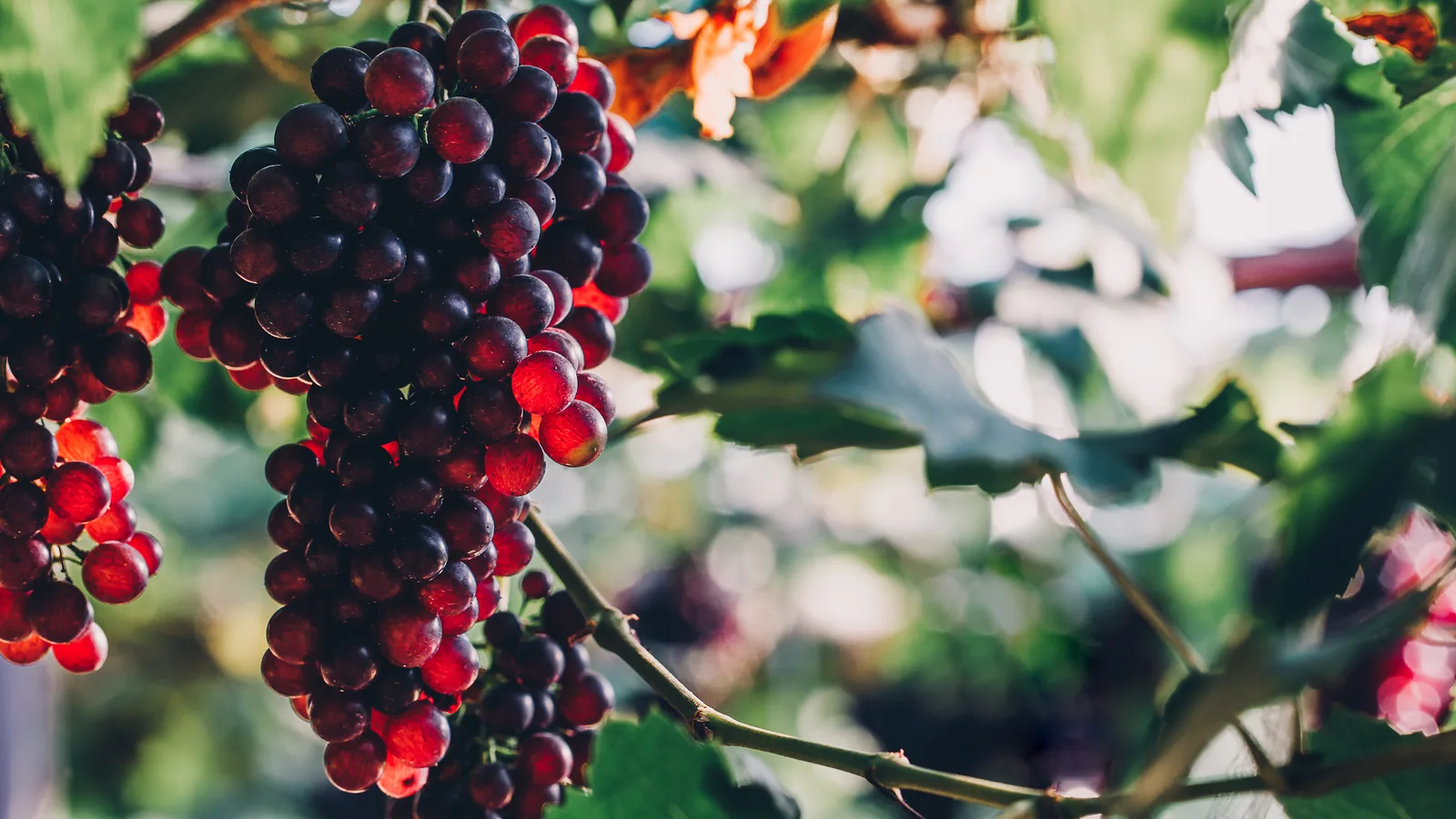
Put a glass of Pinot Noir next to a glass of Cabernet Sauvignon and the difference shows before you take a sip. One is usually lighter and more see-through; the other is darker and grips your mouth harder. Most of that gap comes from three things: the grape's skin, the climate it needs, and what the winemaker does with what the vineyard hands over.
It starts with the skin
In a red wine, almost all of the color and most of the tannin come from the grape skins. Tannin is the compound that makes your mouth feel dry and slightly grippy, the same sensation as strong black tea. The juice of most red grapes is nearly clear, so the skins do the heavy lifting.
The Oregon Wine Board describes Pinot Noir as a thin-skinned grape and Cabernet Sauvignon as a thick-skinned one. That single difference explains a lot. Less skin relative to juice means less pigment and less tannin to pull into the wine, which is why Pinot Noir so often looks translucent and feels lighter in body.
Cabernet Sauvignon goes the other way. Foundation Plant Services at the University of California, Davis notes that the variety grows small, dark berries, and that its thick skins bring high tannin, acidity, deep color and a strongly astringent flavor. Small berries mean more skin for every drop of juice. UC Davis adds that Cabernet wine usually needs time in the bottle or blending with other grapes to soften that edge, and the Oregon Wine Board points out that winemakers often blend it with lower-tannin grapes for the same reason.
Climate: cool coast versus warm valley
The two grapes want very different weather.
Pinot Noir ripens with relatively little heat. UC Davis puts its needs at about 1,150 degree days (a running measure of growing-season warmth) and notes that it can mature in a short season. In California it does well in the cooler coastal areas touched by fog, breezes and ocean air, such as the Russian River Valley, Carneros and Santa Maria. In Oregon it is the flagship: the Oregon Wine Board reports that Pinot Noir covers 59% of the state's planted vineyard acres, grown mostly in cool sites, above all the Willamette Valley. The board describes Oregon Pinot as tending toward brighter, higher-acid wines, with fruit that runs from red to black and spice notes such as cinnamon or mint.
Cabernet Sauvignon is a late starter and a late finisher. UC Davis calls it a late-budding, late-ripening vine with a long growing cycle, and says it does best in warm conditions that are tempered by cooling marine air. When the climate is too cool, the grape can show a green, herbaceous aroma; when it is too hot, it loses its usual varietal character. Its home ground historically is the gravelly Left Bank of Bordeaux, in the Médoc and Graves. In California it was the state's largest red wine grape crop in 2017, with 91,834 acres planted, according to UC Davis, and it is grown in moderately warm regions such as the Napa Valley. Napa Valley Vintners describe their region as a dry Mediterranean climate, a type found on only about 2% of the planet.
In Oregon, the board notes, Cabernet Sauvignon is only 4% of planted acres, grown in the warmer Columbia Valley, Rogue Valley and Snake River Valley rather than the cool Willamette.
What winemaking adds
Grapes set the starting point, and the cellar shapes the finish. Because Cabernet starts with so much tannin and color, winemakers have plenty to work with and often lean on aging and blending to round it out. UC Davis notes that Cabernet wine can hold its structure for decades.
Pinot Noir gives the winemaker less raw material, so the decisions show more. The variety is also unusually changeable: UC Davis describes Pinot as genetically unstable, with many clones (distinct selections of the same grape) that differ in color, cluster size and yield. A Pinot made from one clone on one hillside can look quite different from a neighbor's.
What that means in your glass
- Color: expect Pinot Noir to be lighter and more transparent; expect Cabernet Sauvignon to be darker, often close to opaque.
- Texture: Pinot usually feels lighter with softer tannin; Cabernet usually feels fuller with firmer, drying tannin.
- Acidity: cool-climate Pinot from Oregon tends toward bright acidity, per the Oregon Wine Board.
- Food: the firmer tannin in Cabernet tends to suit richer, fattier dishes; lighter Pinot is the easier match for roast poultry, salmon and mushrooms, which makes it a common Thanksgiving pick.
Try it at home
The clearest way to learn the difference is a side-by-side pour. Pick up one Pinot Noir from a cool region, such as Oregon's Willamette Valley or California's Russian River Valley, and one Cabernet Sauvignon from a warm one, such as the Napa Valley. Pour a small glass of each, hold them against a white napkin to compare the color, then notice which one dries your mouth more. At the shop, ask for the region on the label, not just the grape, since the place tells you a good part of what is in the bottle.
Loading comments…