






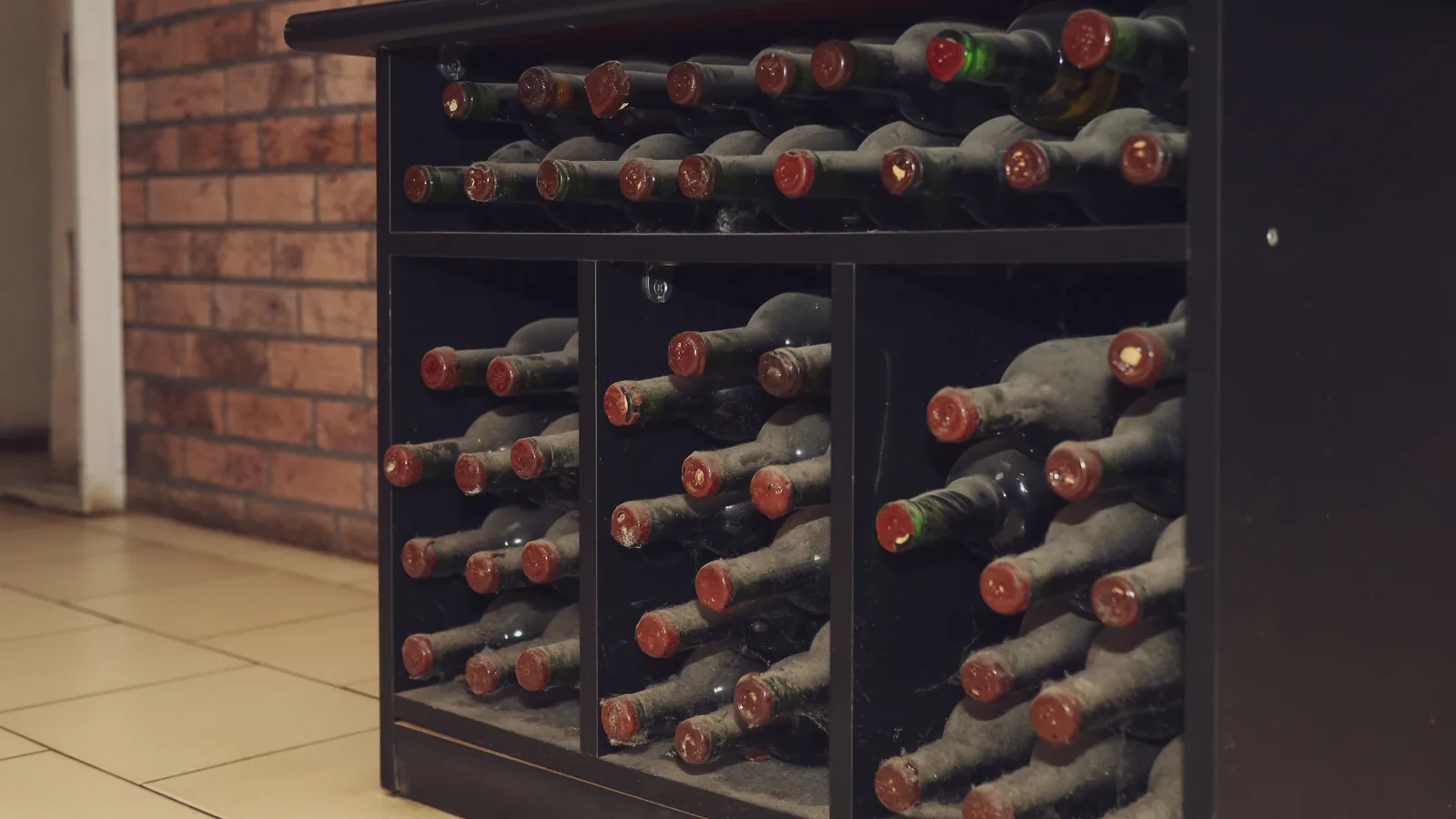
Most wine never needs a cellar. It needs a spot that stays cool, steady and dark, away from the oven and the window. That describes a closet, a basement corner or the space under a bed in a lot of homes. Here is what the research and the wineries themselves say matters, and what you can safely ignore.
Temperature: cool, and above all steady
Heat is the main thing that ages wine faster than intended. The Australian Wine Research Institute, the national research body for Australia's wine industry, summarizes studies showing that storage above about 77°F (25°C) for long periods, or above 104°F (40°C) even briefly, can damage quality, dulling fresh fruit and in extreme cases leaving cooked or oxidized flavors. It also warns against day-to-night temperature swings, and notes that heat can push a cork up or cause a bottle to leak.
How cool is cool enough? Missouri State University's guide to making wine for home use describes an ideal storage spot as about 60°F with an even temperature. The University of Minnesota's enology specialist puts the ideal temperature for wine that is maturing at 55°F, with 60°F as the upper limit. For bottles you will open within a year or two, steadiness matters more than hitting an exact number.
Places that tend to fail the test: the top of the refrigerator (warm and vibrating, which the Missouri State guide specifically warns against), a cabinet next to the stove or dishwasher, a sunny windowsill, an attic, a garage that freezes in January and bakes in July, and the trunk of a car.
Light: keep it dark
Light can create what winemakers call a lightstruck fault. The AWRI explains that light exposure produces volatile sulfur compounds that reduce a wine's quality, and it lists light alongside temperature and humidity as a main storage factor. The Missouri State guide also says to keep wine out of direct sunlight. A closed closet or the box the wine came in is enough.
Humidity: only a concern for long-term corked bottles
Very dry air can shrink a natural cork over time and let wine seep out or air in. The Missouri State guide suggests relatively high humidity, and the AWRI notes that most commercial storage spaces do not control it at all. For a bottle you plan to keep a few months, room humidity is fine. If you keep corked wine for years in a very dry house, a basement or a wine fridge is the better spot.
On its side, or standing up?
The standard advice is to store bottles with natural corks on their sides so the wine keeps the cork moist, and screw-capped bottles upright. That is the Missouri State guide's recommendation. The research is more relaxed than the habit: studies summarized by the AWRI found little difference in color or taste between upright and horizontal storage for a Chardonnay and a Riesling over five years, though upright storage with agglomerated corks (made from pressed cork granules) did show more oxidation. Laying corked bottles down costs nothing and takes up less space in a rack, so it is still the easy default. Screw caps can go either way.
Do you need a wine fridge?
A wine fridge, or wine cooler, is a small appliance that holds bottles at cellar temperature, and the Missouri State guide mentions freestanding and built-in units as an option for home storage. It is worth considering if your home runs warm in summer, if you have no dark closet or basement, or if you are keeping bottles for more than a year or two. Your kitchen refrigerator is fine for chilling a bottle before dinner and for an open bottle, but it is much colder and drier than wine storage targets, so it is a poor place for long-term keeping.
Most wine is made to drink young
Many bottles are not meant to wait, and producers often say so on their technical sheets:
- Aveleda tells drinkers to open its Fonte Vinho Verde within two to three years of bottling, and to store that screw-capped bottle upright in a cool, dry place away from light (Aveleda technical sheet).
- Inter Beaujolais describes Gamay as making fruit-forward wines that can be enjoyed young, though some are built to cellar (Inter Beaujolais).
- By contrast, Lapostolle gives its Grand Selection Carmenère an aging potential of five to eight years (Lapostolle technical sheet), and Terrazas de los Andes puts its Reserva Malbec at five to ten years (Terrazas technical sheet).
If a producer expects a wine to improve with age, it usually says so and gives a window.
A simple setup that works
- Pick the coolest dark closet or basement corner in your home, away from appliances, heating vents and outside walls.
- Use a basic rack or the cardboard case the wine came in, turned on its side for corked bottles.
- Put the bottles you will open soonest in front.
- Look up each wine's drinking window on the producer's website and write the year on a tag or the case.
Then check the spot with an inexpensive thermometer in July. If it reads above about 75°F, that is the time to look for a cooler corner or a small wine fridge.
Sources
- Australian Wine Research Institute: Transport and storage
- Missouri State University: Making Wine for Home Use (MS-28), including Storing Wine (PDF)
- University of Minnesota Grape Breeding and Enology Project: Proper wine storage and maturation
- Aveleda: Fonte Vinho Verde White 2025 technical sheet (PDF)
- Inter Beaujolais: Gamay grape variety
- Lapostolle: Grand Selection Carmenère 2024 technical sheet (PDF)
- Terrazas de los Andes: Reserva Malbec 2024 technical sheet (PDF)
Loading comments…