












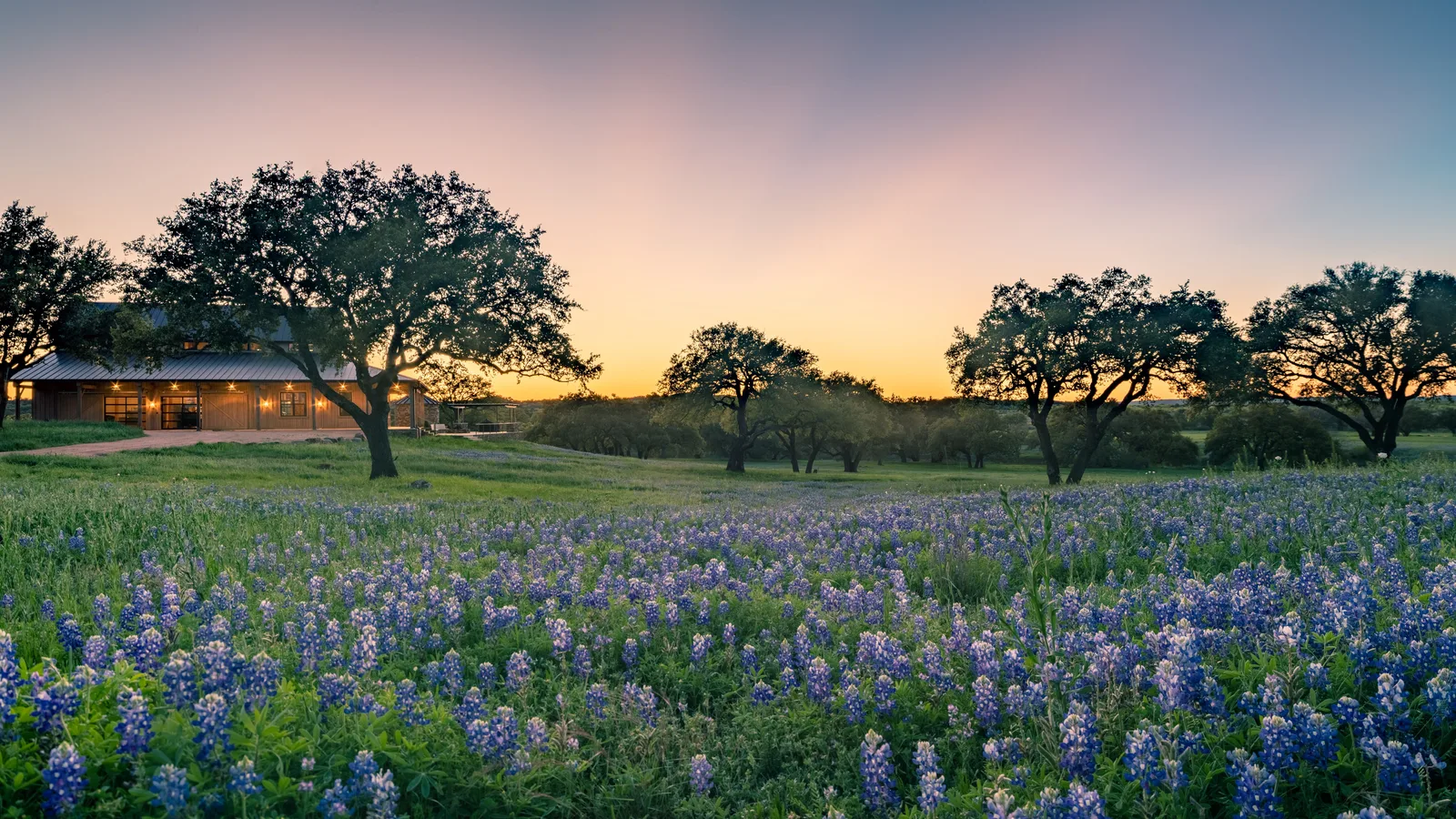
Ask someone to picture Texas wine country and they will probably describe the Hill Country west of Austin and San Antonio: live oaks, limestone, bluebonnets in spring and tasting rooms along the roads around Fredericksburg. That picture is right about where people go to taste. It leaves out the other half of the state's wine map, the flat, high farmland around Lubbock, and the label on a Hill Country bottle will often tell you which half the grapes came from.
Texas Hill Country: the destination
The Texas Hill Country AVA (American Viticultural Area, a federally defined grape-growing region) was established on November 29, 1991, and amended in 1993. Its rule, 27 CFR 9.136, takes in portions of 23 counties, from McCulloch and San Saba in the north to Uvalde, Medina and Bexar in the south, with Gillespie, Blanco, Burnet, Llano, Kendall and Travis among them. Its boundary is traced along highways: Interstate 35, U.S. 183, U.S. 83, U.S. 90 and San Antonio's Loop 410.
Inside it sits a smaller AVA, Fredericksburg in the Texas Hill Country (27 CFR 9.125), the area around the town most visitors use as a base.
Texas High Plains: the farmland
The Texas High Plains AVA, established on March 2, 1993 (27 CFR 9.144), covers 24 counties of the Panhandle and South Plains, including Lubbock, Hale, Terry, Gaines, Dawson, Hockley and Lynn. Part of its boundary is drawn along the 3,000-foot elevation contour, which makes it high, open country.
The two regions are a long day's drive apart, and nothing stops a winery in one from making wine with grapes grown in the other. The label is where that shows.
What the label tells you
Federal rules (27 CFR 4.25) set the minimums. A wine labeled with an AVA must come at least 85 percent from grapes grown in that AVA. A wine labeled simply Texas needs at least 75 percent Texas grapes.
- Texas Hill Country or Fredericksburg in the Texas Hill Country: at least 85 percent of the grapes grew in that region.
- Texas High Plains: at least 85 percent from the High Plains, even when the winery and its tasting room are in the Hill Country.
- Texas: at least 75 percent from somewhere in the state, which may be a blend of regions.
- American, or no Texas appellation at all: the grapes may have come from out of state. It is worth asking.
None of these is a judgment about quality. They are a statement of where the fruit grew, and reading them is the quickest way to know what you are tasting.
Planning a Hill Country tasting trip
- Base yourself in one place. Fredericksburg puts you inside its own AVA, with many tasting rooms on the roads around town.
- Book ahead, especially on weekends and in the holiday season. Many tasting rooms take reservations and charge a tasting fee.
- Do not drive between tastings. The wineries are spread out along highways, so the distances add up. Book a tour, hire a driver or name a designated driver before the first pour. Our guide to planning a winery day around the ride home covers the options.
- Read the label at the counter. Ask which wines are made from Hill Country fruit and which from the High Plains; the AVA on the bottle answers it.
Sources
- Electronic Code of Federal Regulations: 27 CFR 9.136, Texas Hill Country
- Electronic Code of Federal Regulations: 27 CFR 9.125, Fredericksburg in the Texas Hill Country
- Electronic Code of Federal Regulations: 27 CFR 9.144, Texas High Plains
- Electronic Code of Federal Regulations: 27 CFR 4.25, appellation of origin
Loading comments…