










Read enough winery tech sheets or back labels and you will meet the phrase malolactic fermentation, often shortened to ML or MLF. It is one of the most important choices a winemaker makes, it is the reason some Chardonnay tastes like buttered popcorn and some tastes like lemon, and it is not a fermentation in the sense most people mean. Here is what it does and how to tell whether a wine went through it.
Not yeast this time, but bacteria
The fermentation everyone knows is alcoholic fermentation: yeast eats the sugar in grape juice and turns it into alcohol. Malolactic fermentation is a second, separate process. Lactic acid bacteria, mainly a species called Oenococcus oeni, convert the wine's malic acid into lactic acid, according to Oregon State University's Extension Service, which publishes guidance for the state's winemakers.
The swap matters because the two acids taste very different. Malic acid is the sharp, green-apple acid of an unripe apple. Lactic acid is the softer acid found in milk and yogurt. Trading one for the other lowers a wine's overall acidity and makes it taste rounder and smoother.
Why winemakers use it
- To soften acidity. Oregon State notes it is especially useful for cool-climate wines with high malic acid, where lowering the acidity brings the wine into balance.
- For stability. A wine that has finished its malolactic fermentation will not start one later in the bottle, where it could leave a wine cloudy or slightly fizzy when it should not be.
- For flavor. The bacteria produce a compound called diacetyl, which smells of butter. Oregon State says that at low levels it can be desirable, depending on the style, while above about 5 milligrams per liter it can become objectionable.
Which wines go through it
Oregon State says malolactic fermentation is used mostly in red wines and in some whites. Most red wines go through it as a matter of course, which is part of why reds rarely taste sharply tart. Among whites it is a style decision. Chardonnay is the classic example: a Chardonnay given full malolactic fermentation, often in oak barrels, comes out rich and creamy; one where the winemaker blocked it, usually in stainless steel, stays crisp and citrusy. Aromatic whites such as Riesling and Sauvignon Blanc are usually kept from going through it, because their bright acidity is the point.
How the winemaker controls it
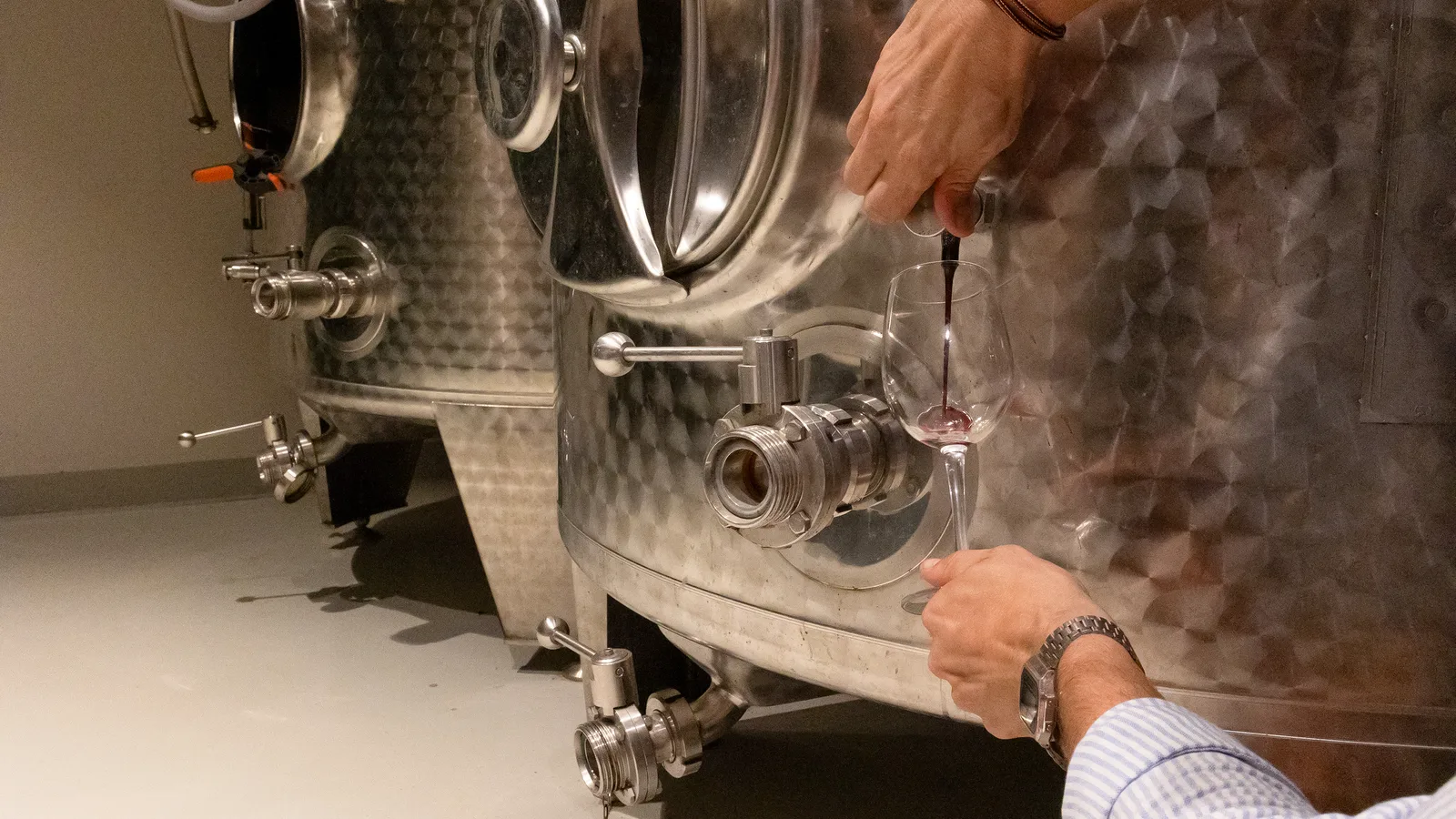
Traditionally the bacteria came from the grapes or the winery and the process started on its own, sometimes months later in a cold cellar. Today most wineries add a commercial culture so they control the timing. Oregon State's checklist for a successful malolactic fermentation gives the conditions the bacteria need: a temperature of about 64 to 71 degrees Fahrenheit, very little free sulfur dioxide, a pH of about 3.2 to 3.5 and alcohol below about 13.5 percent. Winemakers check progress by sampling the wine from the tank or barrel, and they consider it finished when malic acid falls below about 30 to 50 milligrams per liter, confirmed by a lab test, before they add sulfur dioxide to protect the wine.
The timing can also shape flavor. Malolactic fermentation usually runs after alcoholic fermentation, but it can be run at the same time. Oregon State notes that running the two together tends to leave less diacetyl, so a winemaker who wants a buttery Chardonnay generally lets it follow fermentation, while one who wants a cleaner style may run them together.
How to tell from the bottle
The front label almost never says. The back label or the winery's technical sheet often does, in phrases like 100% malolactic, full ML, partial malolactic or no malolactic. A few more clues: a white described as buttery or creamy has very likely been through it; one described as crisp, unoaked or stainless steel fermented very likely has not. If you know you like one style and not the other, the question to ask at a shop is simply whether the wine went through malolactic.
Loading comments…